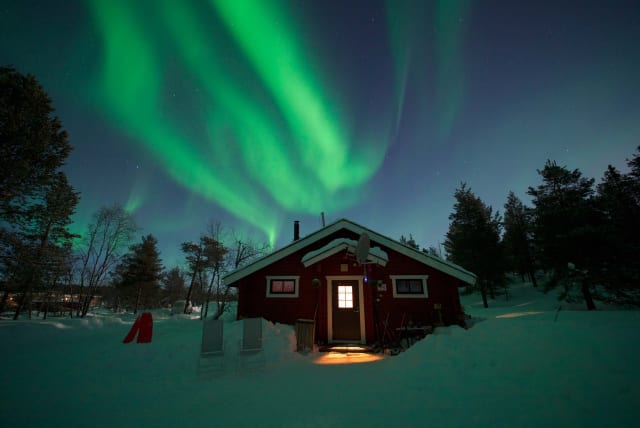
Northern Lapland isn’t an open-air museum of Sámi culture. It’s home.
People go to work, take their children to school, herd reindeer, fish, run businesses and live modern everyday lives, just like anywhere else. The same area is home to the Sámi, the only recognised indigenous people in the European Union, and to languages and livelihoods whose history didn’t begin with tourism.
A good traveller starts from there.
Where is the Sámi homeland?
In Finland, the Sámi homeland covers the municipalities of Enontekiö, Inari and Utsjoki and the northern part of Sodankylä.
It isn’t one uniform destination. Inari, Utsjoki, the Kilpisjärvi area and Vuotso are all different places. Three Sámi languages are spoken in Finland: North Sámi, Inari Sámi and Skolt Sámi. According to the Sámi Parliament, all of them are endangered.
The homeland isn’t the only place where Sámi people live, either. Of the roughly 10,000 Sámi in Finland, more than 60 per cent live outside it.
Inari is an easy place to start
In Inari village, visitors can learn about Sámi culture through its institutions and through Sámi-run businesses.
Siida, the Sámi museum and nature centre, gives background on the area’s nature, history and cultures. The Sámi cultural centre Sajos is a key building for Sámi society today and houses, among others, the Sámi Parliament.
This is a good starting point before you try to interpret individual tourism experiences.
Choose a Sámi provider when you buy Sámi culture
If a trip is sold specifically as Sámi food, handicraft, storytelling or a cultural experience, check who is behind it.
The Sámi Parliament’s ethical guidelines for tourism were drawn up, among other things, to end tourism that exploits Sámi culture and to stop the spread of false information about the Sámi. The guidelines emphasise respect for cultural heritage, the wellbeing of local communities and responsible communication.
A simple practical rule: if you’re buying culture, try to buy it from the people whose culture it is.
Not all reindeer herding is Sámi
This is an important distinction.
Reindeer are herded across a wide area of northern Finland by both Sámi and other Finns. A reindeer doesn’t automatically make a tourism service Sámi.
Nor should you assume that every Sámi person is a reindeer herder. The culture is much broader than one livelihood.
Don’t dress up as “a Sámi”
Sámi dress (gákti in North Sámi) isn’t a general national costume of Lapland or a fancy-dress outfit for tourists.
If a tourism service offers visitors an outfit resembling Sámi dress for a photo, be critical. A genuine cultural encounter doesn’t require the visitor to dress up as someone else.
Ask before photographing people
A fell landscape doesn’t need permission to be photographed. People deserve courtesy.
Don’t photograph local people, reindeer work, private events or people’s yards as if they were sights. If you’d like a photo, ask.
This matters especially when you arrive in the middle of people’s work or community life.
Don’t disturb the reindeer
Reindeer roam freely over large areas, but they are semi-domesticated, and each one has an owner.
Don’t walk towards a herd to get a better photo. Keep dogs under control and give the animals space. On the road, slow down when you see a reindeer: there are usually more nearby.
Utsjoki: travel to a village, not to a “wilderness”
Utsjoki is Finland’s northernmost municipality and a strongly Sámi area.
Tourism adverts easily describe the north as empty wilderness. The landscape may look empty, but it has users, names, history and meaning. A road, a river, a fell and a reindeer pasture can all be part of someone’s everyday surroundings.
The same goes for Enontekiö and the Kilpisjärvi area.
Buy local with care
There’s a difference between genuine Sámi handicraft and a souvenir that merely looks Sámi.
If you care about where something comes from, ask who made it and where. A good seller can answer. Handicraft, food or services bought from a local maker leave money in the area and bring a real person into the story.
Read also about Lappish and Sámi food.
Before you go
Read the Sámi Parliament’s guide for responsible visitors. It’s good preparation because the guidance comes from the community itself.
And while you travel, remember one simple thing: you’re not arriving at a film set. You’re a guest in a place where other people live their lives at home.
That’s exactly why the experience is more interesting than any version built for tourism.